


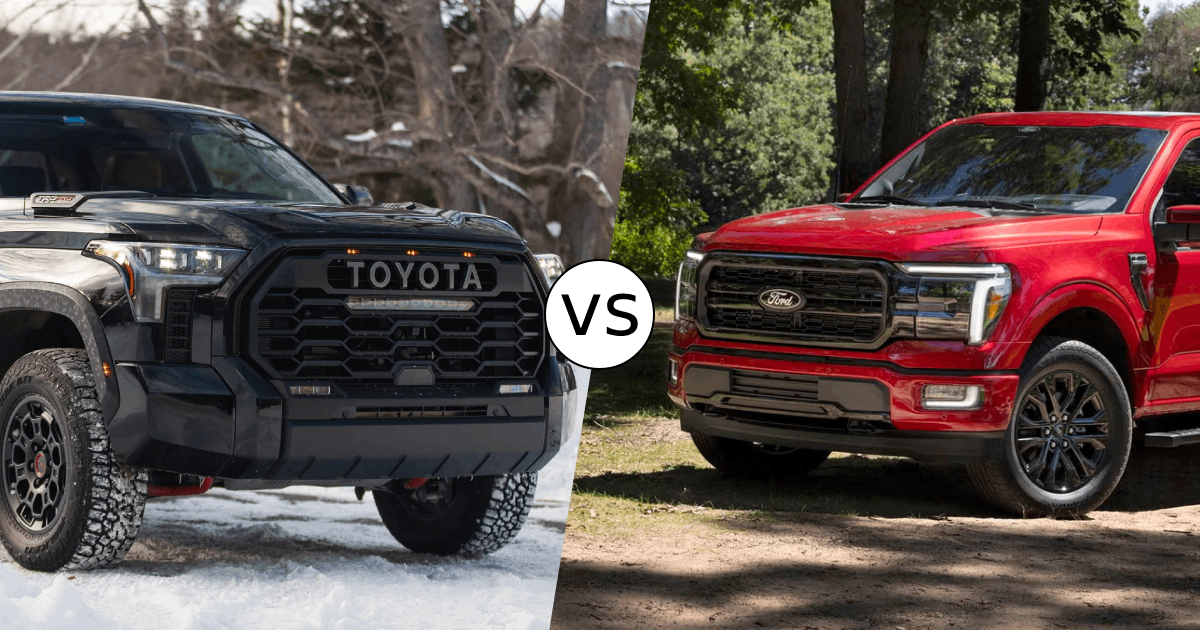
When North Texas truck buyers stack the 2026 Toyota Tundra against the Ford F-150, the comparison comes down quickly to what actually matters: performance under load, long-term dependability, and real ownership value. Both trucks earn serious consideration, but the Tundra consistently pulls ahead where it counts. We’ve put these two through a thorough head-to-head comparison, and our verdict is clear. If you’re ready to see what’s available right now, you can browse our Tundra inventory and find the configuration that fits your needs.
The Tundra’s 2026 story is one of continued refinement. Toyota has built on a strong foundation with the i-FORCE MAX hybrid powertrain, a well-earned durability reputation, and an interior that competes with premium trucks. It’s a pickup that works just as well for a construction crew as it does for a weekend road trip with the family. This breakdown covers every angle that matters.
Head-to-Head Comparison: 2026 Tundra vs. F-150 Key Specs
Putting these two trucks side by side shows a detailed but meaningful picture. The i-FORCE MAX delivers stronger horsepower, torque, and payload numbers, while the F-150 PowerBoost edges ahead in fuel economy and holds a narrow 150-lb towing advantage.
The Tundra’s 22 mpg combined (RWD) versus the F-150 PowerBoost’s 25 mpg combined (RWD configurations) is an honest gap worth acknowledging, particularly for buyers with long daily commutes. But for buyers who prioritize horsepower, payload, and long-term warranty coverage on the hybrid system, the Tundra’s advantages are more consequential.
| Specification | 2026 Toyota Tundra Hybrid | 2026 Ford F-150 Hybrid |
| Engine | 3.4L twin-turbo V6 + hybrid | 3.5L twin-turbo V6 + hybrid |
| Horsepower | 437 hp | 430 hp |
| Torque | 583 lb-ft | 578 lb-ft |
| Transmission | 10-speed automatic | 10-speed automatic |
| Max Towing | 11,450 lbs | 11,600 lbs |
| Max Payload | 1,850 lbs | 1,740 lbs |
| EPA Combined (RWD) | 22 mpg | 25 mpg |
| Hybrid Battery Warranty | 10 years/150,000 miles | 8 years/100,000 miles |
The F-150 PowerBoost holds a narrow 150-lb towing advantage and a real fuel economy edge, and we won’t pretend otherwise. But the Tundra’s payload lead, higher horsepower and torque output, standard safety technology, and longer hybrid battery warranty coverage add up to a stronger overall package for hybrid-truck buyers focused on long-term ownership.
Powertrain Performance: Where the Tundra Sets the Standard
Power and efficiency used to be opposites in the truck world, but the 2026 Tundra challenges that assumption directly.
i-FORCE MAX Hybrid vs. F-150 PowerBoost: Power Meets Efficiency
Toyota’s i-FORCE MAX hybrid system pairs a 3.4L twin-turbocharged V6 with an electric motor integrated directly into the transmission, producing 437 horsepower and 583 lb-ft of torque. That torque arrives the moment you touch the accelerator, which is a genuine advantage when merging onto a highway with a loaded trailer or pulling out of soft terrain around Prosper.
The F-150 PowerBoost hybrid is a capable system, producing 430 horsepower and 578 lb-ft of torque, with no real questions about its capability. But the Tundra’s hybrid architecture is specifically tuned for performance under load. Where the PowerBoost leans into fuel savings, the i-FORCE MAX prioritizes the kind of urgent power delivery that matters in demanding situations.
Towing, Payload, and Real-World Capability
The i-FORCE MAX hybrid system delivers up to 11,450 lbs of max towing capacity, backed by standard integrated trailer brake control and trailer sway control. The Tundra’s gas-only i-FORCE V6 pushes that figure to 12,000 lbs for buyers who prioritize maximum towing over hybrid efficiency. In a hybrid-to-hybrid matchup, Ford’s F-150 PowerBoost holds a narrow 150-lb edge at 11,600 lbs, though reaching that figure requires the Tow/Haul Package and Max Tow Axle upgrade, which add to the purchase price.
On payload, the hybrid comparison favors the Tundra. The i-FORCE MAX delivers a maximum payload of 1,850 lbs, ahead of the F-150 PowerBoost hybrid’s 1,740 lbs. Buyers who need maximum overall F-150 payload can step up to the 5.0L V8 configuration, which Ford rates at 3,325 lbs, but that means moving away from the hybrid powertrain entirely. For hybrid-truck buyers in Prosper who regularly haul materials, equipment, or gear, the Tundra’s payload advantage is real and measurable.
Reliability and Long-Term Ownership Costs
When buyers ask whether the Tundra holds up better than the F-150 over the long haul, the data supports a strong lean toward Toyota. That advantage shows up not at the dealership, but in year three, year five, year ten, when you’re still driving the same truck and haven’t had a reason to worry about it.
The Numbers Behind the Tundra’s Long-Term Value
The Tundra has built one of the strongest resale stories in the full-size segment. Kelley Blue Book’s 2025 Best Resale Value Awards ranked it third among all vehicles in America, projecting it will retain 60.9 percent of its original value after five years. That residual strength compounds over a five or ten-year ownership window, and it shows up in real ownership economics too.
RepairPal pegs the Tundra’s average annual repair cost at $606, compared to $788 for the Ford F-150, a $182 yearly gap that translates to roughly $910 over five years. Tundra owners also average just 0.3 unscheduled shop visits per year, in line with the best trucks in the class and below the 0.4-visit industry average.
If you’re thinking about trading in your current truck, you can get an instant cash offer and see exactly what your vehicle is worth before you shop.
Warranty Coverage and Total Cost of Ownership
Toyota backs the Tundra with a 3-year/36,000-mile basic warranty and a 5-year/60,000-mile powertrain warranty, comparable to Ford’s F-150 coverage at those tiers. The significant gap appears with the hybrid battery. Toyota covers the Tundra’s hybrid battery for 10 years or 150,000 miles.
Ford’s PowerBoost F-150 hybrid battery is covered for 8 years or 100,000 miles under the Hybrid & Electric Vehicle Unique Component coverage. That’s a 2-year, 50,000-mile gap in Toyota’s favor, and for buyers who plan to keep their truck long-term, it’s a meaningful difference.
Eligible new Tundra buyers also receive ToyotaCare, which covers scheduled maintenance for two years or 25,000 miles, reducing out-of-pocket costs during early ownership. When you factor in lower average repair frequency and stronger resale value, the Tundra’s total cost of ownership picture is hard to match.
Interior Quality, Comfort, and Everyday Practicality
For buyers who commute daily, haul the family on weekends, and occasionally handle work duties, the interior experience matters as much as what’s under the hood.
Cabin Materials, Ride Refinement, and Noise Isolation
Step inside a 2026 Tundra and the material quality registers immediately. Soft-touch surfaces, well-fitted trim panels, and thoughtful storage solutions create an environment that punches above its class. Rear legroom is particularly generous, making this a legitimate family hauler rather than an afterthought passenger vehicle. Adults can sit comfortably in the back on long drives without complaint.
Ride quality is a genuine strength. The suspension absorbs road imperfections smoothly, and highway noise isolation is competitive with trucks that cost significantly more. The cabin stays quiet and composed, which becomes especially noticeable on longer hauls across North Texas. Toyota made deliberate engineering decisions to compete at the higher end of the segment, and it shows.
Infotainment Technology and Driver Assistance Features
One of the Tundra’s clearest advantages over the F-150 is that Toyota Safety Sense 2.5 comes standard across all trims. Every Tundra includes a pre-collision system with pedestrian detection, lane tracing assist, adaptive cruise control, and automatic high beams, regardless of where you enter the lineup. On the F-150, several of these features are reserved for higher trims or require optional packages.
The infotainment system centers on a responsive touchscreen with wireless Apple CarPlay and Android Auto. The interface is clean and intuitive, avoiding the cluttered menus found in some competing systems. Pair that with a standard digital instrument cluster and an available head-up display on upper trims, and the technology suite feels modern without being overwhelming.
Trim Levels and Value: How the Tundra Delivers More for Your Money
The Tundra’s trim structure progresses logically through the SR, SR5, Limited, Platinum, 1794 Edition, TRD Pro, and Capstone. That range means there’s a well-equipped Tundra for every buyer type without forcing unnecessary upgrades to access key features.
The Tundra Limited represents one of the segment’s strongest value propositions, delivering genuine luxury appointments and a full technology package at a price that competes directly with comparable F-150 configurations. The Capstone sits at the top, matching F-150 Lariat and Platinum trims in interior refinement but with Toyota’s reliability record as a built-in advantage. And because Safety Sense 2.5 is standard across the lineup, even the entry-level SR buyer gets the full driver assistance suite without paying for a package upgrade.
The Tundra’s consistent advantages across all trim tiers are worth spelling out:
- Toyota Safety Sense 2.5 is standard on every trim, with no required upgrade packages.
- i-FORCE MAX models carry a 10-year/150,000-mile hybrid battery warranty, compared to Ford’s 8-year/100,000-mile coverage on the PowerBoost hybrid, a 2-year and 50,000-mile advantage that compounds for long-term owners.
- Max payload comes in at 1,850 lbs, versus 1,740 lbs for the F-150 in standard configurations.
- Resale value consistently outpaces the F-150, with the Tundra ranked third among all vehicles in America on Kelley Blue Book’s 2025 Best Resale Value Awards, projected to retain 60.9 percent of its value after five years.
Why Tundra Buyers Are Making the Right Call in 2026
The 2026 Toyota Tundra has matured into a fully competitive truck that no longer asks buyers to trade dependability for performance. Capability, technology, comfort, and long-term reliability come together without meaningful compromise.
For hybrid-truck buyers on the fence between these two, the advantage builds over time. A truck that holds its value better, costs less to maintain on average, arrives with the full Toyota Safety Sense 2.5 suite standard across every trim, and backs its hybrid battery with a 10-year warranty is a smarter long-term investment for buyers focused on total cost of ownership.
Find Your 2026 Toyota Tundra at Longo Toyota of Prosper
We carry a full lineup of 2026 Tundra configurations at Longo Toyota of Prosper, from the work-focused SR all the way up to the fully appointed Capstone. Explore available Tundra models online, or stop by our Prosper location to see them in person.
Our team is here to help you find the right configuration and structure a deal that fits your budget, with flexible financing and leasing options available. Contact us at 972-347-4929, Monday through Saturday from 9 AM to 8:30 PM.
Connect with us


