


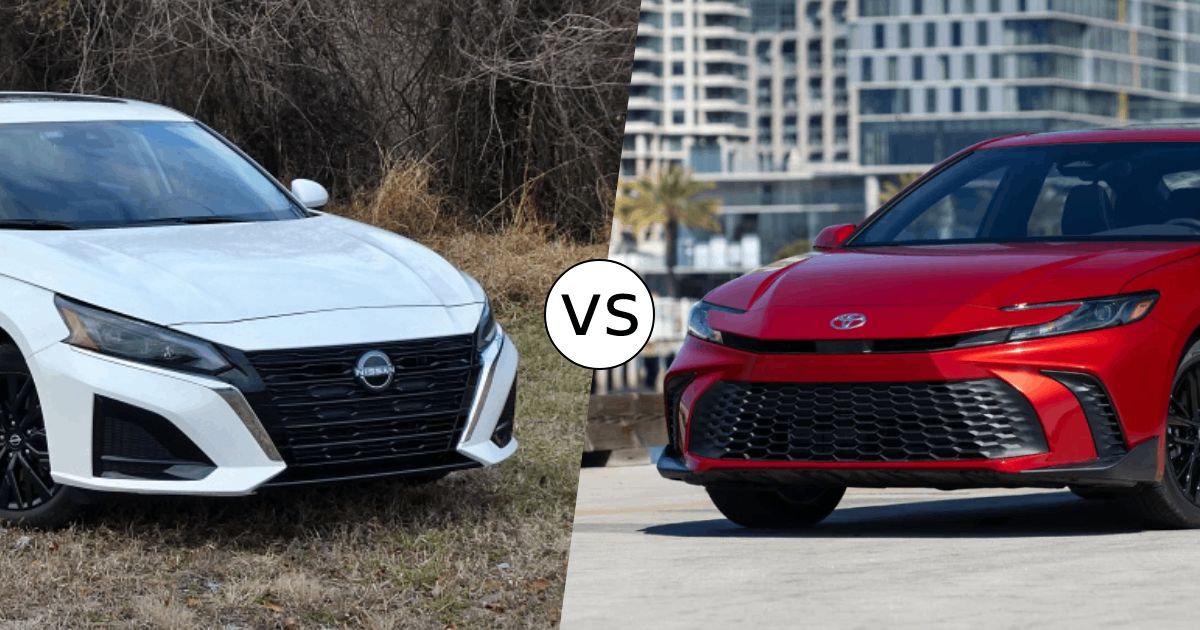
Amongst midsize sedans, the Toyota Camry and Nissan Altima sit at the top of many shopping lists. In this 2025 Nissan Altima and Toyota Camry comparison, our team at Longo Toyota of Prosper examines performance, looks, tech, safety gear, and value to help you pick the right car for your life and budget.
Exterior Design Comparison
Toyota’s 2025 Camry sports a mesh front grille with optional 19-inch wheels. Standard gear includes 16-inch black wheels, sport side panels, a rear diffuser, heated mirrors with turn signals, bi-LED headlights, and LED running lights.
The 2025 Nissan Altima features aerodynamic styling with a signature V-Motion grille with chrome accents and LED headlights. Colors such as Super Black or Garnet Pearl Metallic stand out. Wheel options range from 16-19 inches across trims.
Interior Space and Comfort
The Camry fits five passengers in two rows, with front headroom at 38.3 inches (37.5 inches with moonroof) and rear headroom at 37.6 inches.
Shoulder room measures 57.7 inches up front and 55.7 inches in the rear, while hip room is 55.4 inches and 54.6 inches respectively. There’s 42.1 inches of legroom in front and 38.0 inches in the rear. You get 15.1 cubic feet of cargo room in the trunk, and the total passenger volume is 99.9 cubic feet.
The Altima’s Zero Gravity front seats use NASA tech for superior body support — a real win on those long Texas drives.
The Altima beats the Camry in front legroom (43.8 inches) and headroom (39.1 inches) but has less rear legroom (35.2 inches) and headroom (36.9 inches). The trunk holds 15.4 cubic feet, and 60/40-split folding rear seats expand your cargo capacity, especially for long items. Total passenger space is 100.6 cubic feet.
Engine Options and Powertrain Specifications
Every 2025 Camry goes hybrid-only, in a move that shows Toyota’s commitment to efficiency. A 2.5-liter four-cylinder (184 hp and 163 lb-ft of torque) works with Toyota’s Hybrid System 5 for a combined output of 225 hp (front-wheel drive) or 232 hp (all-wheel drive). This hybrid system pairs with an electronically controlled continuously variable transmission (CVT).
The 2025 Nissan Altima’s 2.5-liter four-cylinder engine also pairs with a CVT. Power varies by drive type: Front-wheel-drive (FWD) models make 188 hp and 180 lb-ft of torque, while all-wheel-drive (AWD) versions drop to 182 hp and 178 lb-ft of torque.
Fuel Economy Comparison: Which Sedan Offers Better Mileage?
The 2025 Camry’s hybrid-only lineup dominates the fuel economy battle. The FWD LE achieves 53 mpg city/50 mpg highway/51 mpg combined, while the AWD version gets 51 mpg city/49 mpg highway/50 mpg combined. The FWD SE rates 48 mpg city/47 mpg highway/47 mpg combined, while the AWD model gets 46 mpg city/46 mpg highway/46 mpg combined. Even the sporty AWD XSE manages 44 mpg city/43 mpg highway/44 mpg combined.
The Altima can’t match these numbers. The S and SV FWD models rate 27 mpg city/39 mpg highway/32 mpg combined. The SR and SL FWD trims drop to 27 mpg city/37 mpg highway/31 mpg combined, while AWD versions achieve 25 mpg city/34 mpg highway/28 mpg combined. The difference is massive: the Camry delivers 44-51 mpg combined vs. the Altima’s 28-32 mpg. If you’re a daily commuter, this means significant fuel savings over time.
Advanced Technology and Connectivity
The Camry’s 8-inch touch screen offers clear graphics and straightforward menus. A 12.3-inch touch screen is available on higher trims. Wireless Apple CarPlay and Android Auto come standard, plus a 7-inch digital gauge cluster (with optional 12.3-inch version on pricier trims). There’s also a six-speaker audio system or an optional nine-speaker JBL premium audio.
Standard features include five USB ports, a wireless charging pad, a three-month SiriusXM trial, Bluetooth, and dual-zone climate control. Toyota throws in a 10-year trial for connected services and a 30-day Wi-Fi hot spot subscription.
The Altima comes standard with an 8-inch touch screen, Apple CarPlay and Android Auto, and NissanConnect with a Wi-Fi hot spot. The top SL trim gets a 12.3-inch touch screen and wireless Apple CarPlay and Android Auto. Options include navigation and wireless charging. All versions get keyless entry and remote start. Nice extras include an optional Bose nine-speaker audio system and a 360-degree camera. Nissan offers a three-to-five-year connected service trial.
Safety and Driver-Assistance Features
All 2025 Camrys have Toyota Safety Sense 3.0, which includes a Precollision System with Pedestrian Detection, Full-Speed Range Dynamic Radar Cruise Control, lane departure alert with steering assist, plus other driver-assistance features. The Camry also has eight airbags, collision sensors, and a backup camera. The National Highway Traffic Safety Administration (NHTSA) gave the 2025 Camry a five-star overall rating and the Insurance Institute for Highway Safety (IIHS) gave it a Top Safety Pick+ award.
Standard safety gear includes hill-start assist, Toyota’s Star Safety System, and tire pressure monitors. Nice touches include a rear-seat reminder (so kids or pets aren’t forgotten) and headlights that turn with the steering wheel for better night vision. Performance stats show the Camry stops from 60 mph in 118 feet — good numbers that prove it can avoid trouble when needed.
Nissan Safety Shield 360 comes standard on all Altima trims and includes automatic emergency braking with pedestrian detection, rear automatic braking, blind-spot warning, lane departure warning, and high-beam assist.
Upper trims offer ProPILOT Assist with intelligent cruise control and steering assistance. Additional features include a driver attention monitor and a comprehensive airbag system. The NHTSA gave the 2025 Altima a five-star overall rating, but IIHS results show “Good” in small overlap front tests, “Marginal” in moderate overlap front, and “Poor” in side crash tests.
Price and Overall Value
The 2025 Toyota Camry offers four trims: the LE, SE, XLE, and XSE. Prices range from $28,700 for the base LE to $34,900 MSRP for the XSE. Nissan’s 2025 Altima has five trims: the S ($27,000), SV ($27,430), SV Special Edition ($28,520), SR ($28,830), and SL ($33,330).
Although there’s a $1,700 base price gap between these two sedans, the Camry features better standard equipment, such as adaptive cruise control. These features help justify the Camry’s slightly higher cost.
Warranty and Roadside Assistance Coverage
Both sedans offer the typical three-year/36,000-mile basic warranty and five-year/60,000-mile powertrain coverage, plus five-year unlimited-mile rust protection. The Camry includes ToyotaCare with two years/25,000 miles of free maintenance and two years of unlimited-mile roadside help. The Altima provides two years/24,000 miles of free maintenance and three years/36,000 miles of roadside assistance. The Camry’s hybrid components get a solid eight-year/100,000 miles warranty, showing Toyota stands behind its hybrid tech.
Choose Your Perfect Midsize Sedan Today
So, should you choose the Toyota Camry or the Nissan Altima? While they’re both excellent cars, Toyota comes out top in our Altima vs. Camry comparison. Although the Nissan Altima offers NASA-designed seats, a slightly bigger interior and trunk, and a lower starting price, the 2025 Toyota Camry wins if you prioritize fuel savings and value. The Camry’s hybrid powertrain delivers superior efficiency and power, and its top safety ratings outclass the Altima’s mixed results. Visit our Longo Toyota of Prosper dealership to test-drive the 2025 Toyota Camry and find your perfect sedan.
Connect with us


