


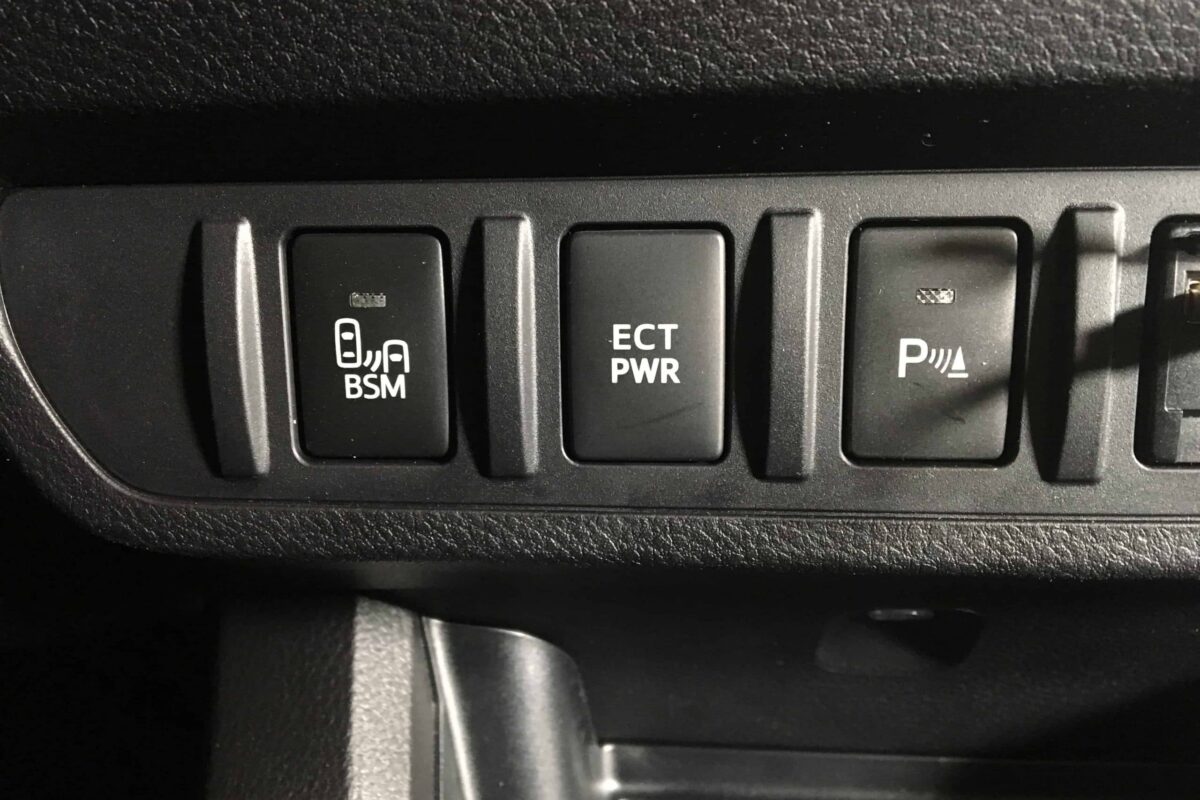
Vehicle safety isn’t only about protecting passengers in case of a crash. Many modern vehicles come with systems that can help the driver detect challenging road situations in time to avoid them safely. Toyota has always put safety at the top of its priority list, and the blind-spot monitor (BSM) system has been available for Toyota models for more than a decade. Keep reading to discover exactly what it is, how it works, and how it can help you avoid dangerous situations.
What is BSM on Toyota: Understanding Blind Spot Monitoring Technology
Toyota’s blind-spot monitoring system is an active safety assist feature that uses multiple sensors to detect other vehicles entering the driver’s blind spots. When the system detects such a situation, it issues a visual warning through an illuminating indicator on the driver’s side-view mirror. If the driver signals a lane change in that direction, the light will start blinking to get their attention. Many Toyota models with BSM also have a rear cross-traffic alert system, which uses the same sensors to detect any vehicle coming from either side when backing up.
Some of the system’s core components are:
- Radar sensors: Scan the left and right lanes to detect any incoming vehicles that enter the driver’s blind spots.
- Electronic control unit: Receives data from the sensors and analyzes it to detect potential hazards.
- Side mirror indicator lights: Activates a small LED light to warn the driver if the ECU triggers a warning.
Some situations when the blind-spot monitor can effectively assist drivers include:
When Changing Lanes
The most common use of BSM technology is when moving from one lane to another. Even if you’re careful and look into the corresponding side mirror before changing lanes, a vehicle may still be beside you in a blind spot. If the BSM indicator doesn’t light up, it usually means the system didn’t detect any vehicles in your blind spot. However, you should still check your mirrors before changing lanes to be on the safe side.
When Merging Onto a Highway
Another common use of this system is when trying to merge onto a busy highway. Finding the right moment to change lanes can be difficult with cars constantly going past you. The BSM system can help you find a safe moment to merge.
When Passing By Smaller Vehicles
When you’re driving a medium or large SUV, such as the Toyota Highlander or RAV4, you may find it challenging to notice scooters, motorcycles, and bicycles passing by. The BSM system lets you know when one of these is next to you.
When Driving in Bad Weather Conditions
If you’re driving in heavy rain, snow, or fog, rearview mirror visibility is limited. The BSM system can reliably reveal other vehicles when they approach, helping you avoid unpleasant situations.
Which Toyota Models Have BSM Technology
Most Toyota models come with BSM systems, either as a standard feature or as an option. All new Toyotas that come with a blind-spot monitoring system also have a rear cross-traffic alert system. Here’s a breakdown of some of the most popular models:
- Toyota Camry: Blind-spot warning with rear cross-traffic warning system is standard on all 2025 Camry models, regardless of trim level.
- Toyota Corolla: BSM is standard on the XSE trim and available as an option on lower trims.
- Toyota RAV4: Toyota Safety Sense suite is standard on all trims and includes blind-spot warning with the rear cross-traffic warning.
- Toyota Prius: Blind-spot warning with rear cross-traffic warning is a standard feature on recent generations, including the 2025 model, and optional on older models.
- Toyota Highlander: Blind-spot warning with rear cross-traffic warning is standard on higher trims and available as an option on lower trims.
- Toyota 4Runner: Blind-spot warning with rear cross-traffic warning system is also standard on this midsize all-terrain SUV.
How to Operate Toyota’s BSM System
While the blind-spot monitoring system is a crucial safety component most of the time, there are special situations when you may need to turn it off. One such situation is when you’re towing a trailer or using a rear bike rack, as any large metal object near the rear bumper can cause false positives. Other situations include driving on very narrow roads or navigating an off-road environment.
Luckily, it’s very easy to turn off if you need to. All you have to do is access the vehicle’s settings through its infotainment system, navigate to the safety or driver assistance section, look for the BSM feature, and turn it on or off. Alternatively, you can visit us at Longo Toyota of Prosper, and we’ll take care of it for you.
BSM Safety Benefits and Statistics
A study by the Insurance Institute for Highway Safety (IIHS) concluded that vehicles equipped with a blind-spot monitoring system experience 14% fewer lane-change crashes than those that don’t. The same study also found that having a cross-traffic alert system boosts that percentage to 23%. Besides helping you avoid collisions when changing lanes and merging into ongoing traffic, having a blind-spot monitor system on your vehicle can also make driving less stressful while also enhancing your car’s resale value, which is already high on Toyotas.
Come See How Toyota’s BSM Works at Longo Toyota of Prosper
The best way to experience how Toyota’s blind-spot monitoring system can help keep you and your family safe is by test-driving one of the brand’s vehicles. Visit us at Longo Toyota of Prosper and test drive the Toyota model that fits you best. Our sales staff will explain how the system works and answer any questions you may have about its features. Contact us today to learn more about how Toyota’s BSM can enhance your driving lifestyle.
Connect with us


