


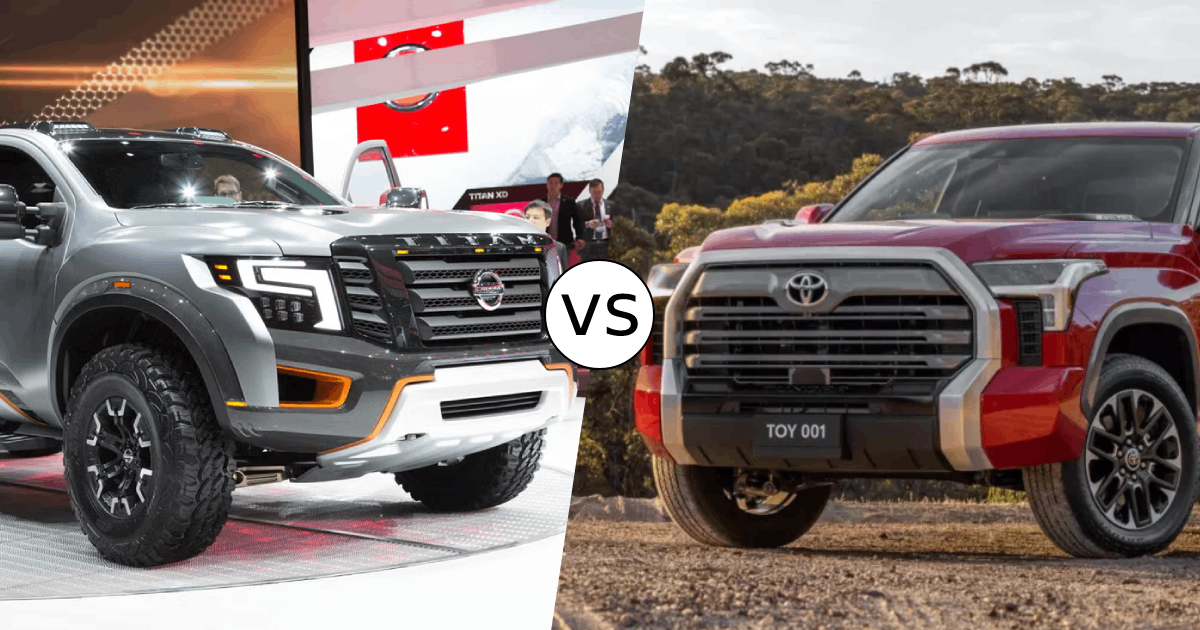
Picking between the 2025 Toyota Tundra and the now-out-of-production Nissan TITAN isn’t simple. Each of these full-size trucks brings something different to your driveway. The Tundra offers hybrid technology with exceptional towing capability, while the TITAN offers traditional V-8 power at an affordable price. Let’s compare auto specs and explore which truck is most cost-efficient, how they both handle Texas roads, and which one might better fit your needs.
Key Specifications at a Glance
Comparing prices, the 2025 Toyota Tundra starts at $40,090 and tops out at $80,725, while the Nissan TITAN starts at approximately $48,700. This disparity reflects the differences in how these manufacturers build their trucks.
Toyota’s Tundra offers three powertrain options, the best of which is an i-FORCE MAX 3.4L twin-turbo V-6 hybrid that delivers 437 hp at 5,200 rpm with 583 lb-ft of torque at 2,400 rpm, working with a 10-speed automatic. Meanwhile, the TITAN uses a 5.6L V-8 engine, producing 400 hp at 5,800 rpm and 413 lb-ft at 4,000 rpm, paired with a nine-speed automatic.
In terms of capacity, the Tundra fits five passengers while the TITAN can seat five or six. For pulling trailers, the Tundra beats the TITAN, providing a 12,000-pound maximum towing capacity when set up right. In comparison, the regular TITAN can tow up to 9,660 pounds, while the TITAN XD can tow up to 11,050 pounds with a gooseneck hitch. As for payload, the Tundra can carry up to 1,940 pounds, but the TITAN XD offers an impressive 2,360-pound maximum. Both trucks are available with different bed lengths to suit different hauling needs.
Engine Performance and Powertrain Comparison
The Toyota Tundra’s i-FORCE MAX hybrid setup is impressive technology, pairing a 3.4L twin-turbo V-6 with electric power fueled by a 1.87 kWh nickel-metal hydride battery. The output of 437 hp and 583 lb-ft of torque translates to approximately 12% more hp and 22% more torque than the standard i-FORCE V-6. Plus, the smart 10-speed automatic shifts smoothly whether you’re cruising on highways or pulling a boat.
In contrast, Nissan sticks to the classics. The TITAN’s 5.6L V-8 produces 400 hp and 413 lb-ft of torque through a nine-speed automatic. This engine isn’t as sophisticated as Toyota’s hybrid, but you may still love its V-8 rumble and straightforward design.
Towing and Payload Capabilities Head-To-Head
In the towing department, the standard Tundra can drag up to 12,000 pounds when properly equipped, making it the perfect option for hauling boats, campers, or heavy work gear. Even the hybrid version handles up to 11,450 pounds, beating both the standard TITAN’s maximum capacity of 9,660 pounds and the TITAN XD’s of 11,050 pounds. If you haul trailers regularly in Texas, this is a significant difference. Toyota also provides a suite of smart towing-assist technology designed to help keep things steady in more difficult driving conditions.
However, the TITAN performs better in terms of payload (what you can carry in the bed). Toyota’s base Tundra SR and SR5 trucks carry up to 1,940 pounds, while the maximum drops to 1,680 pounds for hybrid models due to the added battery weight. Depending on trim and bed configuration, the regular TITAN offers up to approximately 1,700 pounds of payload, but the TITAN XD can haul a massive 2,360 pounds in its bed. If you’re moving gravel, mulch, or construction supplies more than pulling trailers, that’s worth noting.
Fuel Economy and Range Analysis
Fuel efficiency is an important factor in the Nissan TITAN vs. Toyota Tundra comparison, especially with Texas-sized distances involved. Toyota’s hybrid technology pays off here: the i-FORCE MAX hybrid in two-wheel-drive form gets 20 mpg city and 24 highway. The four-wheel-drive (4WD) version isn’t far behind at 19 mog in the city and 22 mpg on the highway. Combined, both hybrid options offer about 22 mpg, saving you money in real terms if you plan to drive long distances.
In contrast, the TITAN’s V-8 consumes more fuel per mile, managing 16 mpg in the city and 21 mpg on the highway. That’s not awful for a V-8, but those extra mpgs add up fast when gas prices increase. As a typical Texan driving 15,000 miles yearly, you could save hundreds at the pump with the Tundra. Tank size matters too. The Tundra is available with a massive 32.2-gallon tank, letting you go much farther between fill-ups than the Nissan’s 26-gallon tank.
Off-Road Capability and 4WD Systems
If you want to take your vehicle off-road, the Tundra TRD Pro comes equipped with FOX shocks that effectively absorb bumps in the terrain. The sophisticated Multi-Terrain Select system works with crawl control, downhill assist, and an electronic locking rear differential to help you conquer rough trails. Alternatively, if you’re not ready for the full TRD Pro, the TRD Off-Road package adds Bilstein shocks and trail-friendly electronics without the bigger price tag.
Nissan’s TITAN tries to keep up with its 4WD system. The PRO-4X trim adds skid plates, sport bars, and off-road tires, but it doesn’t match Toyota’s more advanced off-road technology. If you drive Hill Country trails or sandy East Texas backroads on weekends, the Tundra simply offers more capability.
Reliability, Warranty, and Ownership Costs
Kelley Blue Book named Toyota the Most Trusted Brand and Best Overall Truck Brand in 2023. The 2025 Tundra scored an Insurance Institute of Highway Safety Top Safety Pick award and a five-star rating from the National Highway Traffic Safety Administration (NHTSA). Toyota backs its trucks with a three-year/36,000-mile basic warranty, five-year/60,000-mile powertrain coverage, and an incredible 10-year/150,000-mile hybrid battery warranty. If you’re looking for reliability, Toyota has a reputation you can trust.
Nissan also has a strong brand reputation for reliability. RepairPal gives it a solid 4.0/5.0 rating, ranking it ninth out of 32 brands. Across all models, the average repair cost is about $500 per year, which is less than the $652 industry average. The TITAN has a four-star NHTSA safety rating and comes with a three-year/36,000-mile basic warranty and a five-year/60,000-mile powertrain warranty. That’s good, but it’s not as generous as Toyota’s hybrid battery protection.
Make the Right Choice for Your Needs at Longo Toyota of Prosper, Texas
Your ideal truck depends on what matters most to you. If you value cutting-edge technology, better gas mileage, and towing big loads, the hybrid Tundra’s your best option. If you’d prefer a traditional V-8 engine and care more about up-front costs than long-term value, the TITAN may make more sense to you.
We think that the Toyota Tundra is a clear winner. If you want to see if it feels as good as it looks on paper, contact us at Longo Toyota of Prosper to schedule a test drive.
Connect with us


