


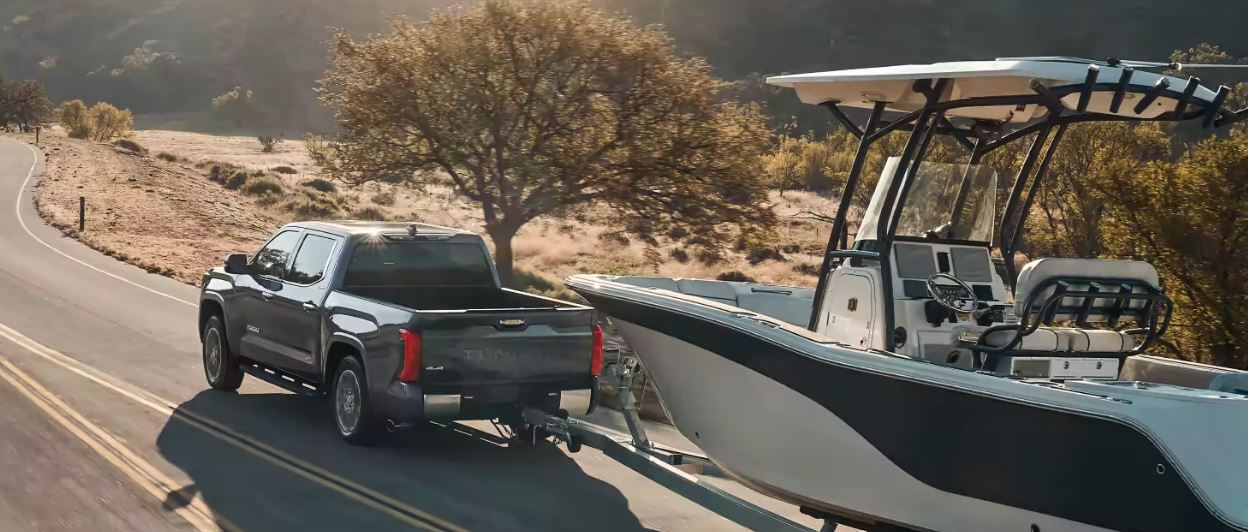
The 2026 Toyota Tundra delivers serious pulling power backed by smart technology that makes hauling heavy loads manageable. Whether you’re planning weekend camping trips with a travel trailer or need reliable equipment transport for work in the North Texas area, understanding what your Tundra can handle ensures you maximize both safety and performance.
At Longo Toyota of Prosper, we help truck buyers match the right configuration to their towing needs, and we’re sharing everything you need to know about the Tundra’s capabilities. Explore our new Toyota trucks to see how these features come together in person.
2026 Toyota Tundra Towing Capacity by Trim Level
The 2026 Tundra pulls up to 12,000 pounds when you get the right setup. Your actual capacity comes down to powertrain choice, drivetrain configuration, cab style, and bed length working together. These combinations don’t just affect numbers on paper – they change how everything feels on the road.
| Configuration | Trims | Drivetrain | Max Tow (lbs) | Max Payload (lbs) |
| 6.5-ft Bed Double Cab | SR, SR5 | RWD | 12,000 (SR5) | 1,850 |
| 6.5-ft Bed Double Cab | SR, SR5 | 4WD | 11,200 (SR5) | 1,850 |
| Base Gas Engine (3.4L V6) | SR | RWD | 8,300 | 1,940 |
| i-FORCE MAX Hybrid | Multiple | Varies | Up to 11,450 | Varies by config |
Standard Powertrain Towing Ratings
The base i-FORCE 3.4-liter Twin-Turbo V6 cranks out 358 horsepower and 406 pound-feet of torque. That’s enough muscle for 8,300 pounds – covering utility trailers, smaller boats, and lightweight campers without breaking a sweat. Step up to higher trims with the upgraded i-FORCE setup, and you’ll hit that impressive 12,000-pound threshold. This opens doors to larger travel trailers and heavier equipment loads that would leave other trucks struggling.
i-FORCE MAX Hybrid Towing Performance
Here’s where things get interesting. The i-FORCE MAX hybrid system delivers 437 horsepower and 583 pound-feet of torque while returning better fuel economy than traditional engines. Maximum capacity reaches 11,450 pounds – nearly matching the standard engine while burning less fuel. That torque figure really shines during acceleration and hill climbing, where the electric motor’s instant power helps pull steep grades confidently. If you’re covering long distances or towing regularly around Prosper and North Texas, this hybrid balances performance with reasonable fuel costs.
Tundra Towing Features That Make the Difference
Toyota didn’t stop at building a strong engine and sturdy frame. The Tundra packs purposeful technology that actively helps drivers manage trailers safely. You’ll get a Class-IV towing hitch receiver and Trailer-Sway Control right out of the box. This system automatically applies brakes and adjusts engine power when it detects dangerous oscillation. The Trailer Backup Guide with Straight Path Assist uses your truck’s display to show projected trailer paths, turning the typically frustrating backing process into something manageable.
Integrated Trailer Brake Controller and Tow/Haul Mode
The factory-installed Integrated Trailer Brake Controller eliminates aftermarket installations while providing seamless integration with your Tundra’s braking system. Press the brake pedal, and both truck and trailer respond proportionally. No more of that unsettling sensation where your trailer pushes forward during stops.
Tow/Haul mode transforms transmission behavior specifically for heavy loads. Shift points adjust to keep the engine in its power band longer, reducing gear hunting on rolling terrain. The transmission also provides more aggressive engine braking when you lift off the accelerator. This helps control speed on descents without riding your brake pedal constantly.
Blind Spot Monitor with Trailer Detection
Standard Blind Spot Monitor with Trailer Detection automatically extends its monitoring range to cover your trailer’s length. It alerts you when vehicles occupy those expanded blind spots during lane changes. The Panoramic View Monitor provides 360-degree visibility for maneuvering in tight spaces. These systems work reliably at highway speeds and prove invaluable on busy highways where merging traffic approaches from angles you can’t see with mirrors alone.
How to Calculate Your Safe Towing Weight
Safe towing isn’t just about meeting Toyota’s maximum numbers. You need to understand how your specific truck, cargo, passengers, and trailer weight interact within Toyota’s designed limits. The GVWR represents the maximum your fully loaded truck can weigh, including all passengers, cargo, and tongue weight from your trailer. Subtract your truck’s curb weight from its GVWR to reveal your payload capacity.
Understanding GCWR and Tongue Weight Guidelines
Gross Combined Weight Rating (GCWR) encompasses your truck’s entire weight plus your loaded trailer’s weight. This is the total mass your Tundra can safely manage while maintaining controllable braking and handling. Staying below this GCWR threshold isn’t optional – it’s essential for safe operation.
Tongue weight should fall between 10 and 15 percent of your trailer’s total weight. Too little causes dangerous sway; excessive tongue weight overloads your rear axle and lifts weight off your front wheels, reducing steering control. Measure tongue weight with a specialized scale before your first trip, then adjust cargo placement inside your trailer to hit that target range. For trailers over 5,000 pounds, use a weight-distributing hitch.
Weigh your loaded truck at a truck stop scale, then calculate remaining capacity before adding trailer weight. This approach prevents guesswork and ensures you stay within safe operating parameters. Load distribution should be 60 percent forward of the trailer axle, 40 percent rearward.
Preparing Your Tundra for Towing
Proper preparation separates smooth towing experiences from roadside emergencies. Before hitching any trailer, inspect your truck and verify all systems are ready for the additional stress towing imposes. Start with your owner’s manual’s towing section for specific recommendations for your configuration.
Pre-Trip Inspection Checklist
Your pre-trip inspection should become routine before every towing trip:
- Check fluid levels (engine oil, coolant, transmission, brakes)
- Inspect tire pressure and tread (vehicle and trailer, including spare)
- Test trailer brakes, lights, and electrical connections
- Verify hitch, safety chains, and weight distribution setup
- Weigh truck and trailer separately to confirm GCWR compliance
Attach safety chains in an X-pattern under the coupler, providing backup if the hitch fails. Check that your side mirrors provide clear views along both sides of your trailer, adding extension mirrors if needed. This visual inspection catches obvious problems before they become serious issues at highway speeds. For professional towing setup and safety inspections, visit our service center where our technicians can ensure everything is configured correctly.
Weight Distribution and Load Balancing
Concentrate heavier items toward the front of the trailer and low to the floor. This creates stability rather than a top-heavy load prone to swaying. Distribute weight evenly from side to side – nobody wants lopsided handling. Weight distribution hitches help level your truck when tongue weight would otherwise cause rear squat. These systems transfer some load forward to your front axle, maintaining proper geometry and steering responsiveness. For larger trailers approaching your truck’s maximum capacity, a weight distribution system becomes essential for safe handling.
Towing Techniques and Driving Tips
Towing transforms how your truck responds to every input. Acceleration becomes more gradual, braking distances extend significantly, and lane changes require extra space and planning. Allow extra time for every trip and accept you’ll travel slower than when driving without a trailer attached.
Acceleration, Braking, and Highway Driving
Accelerate smoothly and patiently, giving your truck time to build momentum gradually. Your Tundra has ample power for safe merging, so don’t feel pressured to floor it. Increase following distance substantially when towing – at least double your normal following distance. This gives you space to brake gradually rather than making emergency stops.
Plan ahead for lane changes and exits, signaling early and moving over gradually. Abrupt steering inputs with a trailer can trigger sway, especially in crosswinds or when passed by large trucks. Keep speeds under 65 mph for optimal stability and fuel economy. Smooth, deliberate movements keep everything stable and predictable.
Backing Up and Maneuvering with a Trailer
Backing with a trailer requires steering opposite your intended direction. Practice in an empty parking lot before attempting tight spaces. Place your hand at the bottom of your steering wheel – moving your hand right makes the trailer go right, left makes it go left.
Make small steering corrections rather than cranking your wheel to full lock. If you’re getting into trouble, pull forward and straighten out rather than trying to save a bad approach. Use the Trailer Backup Guide with Straight Path Assist on your Tundra’s display as a reference, but don’t depend on it exclusively. Spotters help tremendously in tight spaces, especially when you’re still learning.
What Can You Tow with the 2026 Toyota Tundra
The Tundra’s capacity handles everything from weekend camping adventures to professional equipment hauling. Real-world capability extends beyond just meeting weight ratings thanks to robust power, sophisticated features, and solid construction that keeps loads stable at highway speeds.
Travel Trailers, Campers, and Fifth Wheels
The Tundra’s 12,000-pound maximum capacity accommodates substantial travel trailers, perfect for families exploring Texas lakes and campgrounds. Most travel trailers in the 28 to 32-foot range fall within this capability when you account for cargo and supplies. Carefully check your specific trailer’s dry weight and estimate loaded weight before committing to any purchase.
Popup campers and smaller teardrop trailers barely register for the Tundra’s capabilities, leaving plenty of margin for gear, supplies, and passengers. This extra capacity buffer improves fuel economy and reduces mechanical stress during travel. The 48.7 inches between wheel wells accommodates 4×8 sheets, making it easy to load ramps for boat trailers up to 30 feet.
Boats, Equipment, and Utility Trailers
Most recreational boats up to about 24 feet, including the trailer and full fuel tank, stay within safe limits. This covers popular fishing boats, ski boats, and smaller pontoon boats many families enjoy on North Texas lakes. Always weigh your boat with a full fuel load and all gear aboard to verify you’re within limits – fuel adds more weight than most people realize.
Construction and landscaping professionals appreciate the Tundra’s capability for equipment transport. Compact excavators, skid steers, and utility trailers loaded with tools fall comfortably within the truck’s capabilities. The robust frame and available payload up to 1,940 pounds work together to handle demanding daily use without compromise.
Explore the 2026 Toyota Tundra at Longo Toyota of Prosper
We invite you to experience the Tundra’s towing features firsthand at Longo Toyota of Prosper. Our team brings deep expertise about matching the right Tundra configuration to your specific needs, whether pulling campers on family vacations or hauling equipment for your business. Explore our new vehicle inventory to see available configurations and how cab styles, bed lengths, and powertrain choices affect real-world towing.
Located at 2100 W. University Drive in Prosper, Texas, we provide transparent information about Toyota tow package options across different trims. Beyond initial purchase, our factory-trained technicians understand the specific maintenance requirements towing places on your Tundra. Regular inspections of your hitch, brake controller, and suspension components keep everything operating safely.
Ready to experience the 2026 Toyota Tundra’s capabilities? Contact our team at 972-347-4929 or visit Monday through Saturday. We’re here to ensure you drive away confident in your choice.
Connect with us


