

Longo Toyota of Prosper

Blog / Comparison

2023 Toyota Tacoma vs 2023 Toyota Tundra

Toyota Tundra Vs Toyota Tacoma

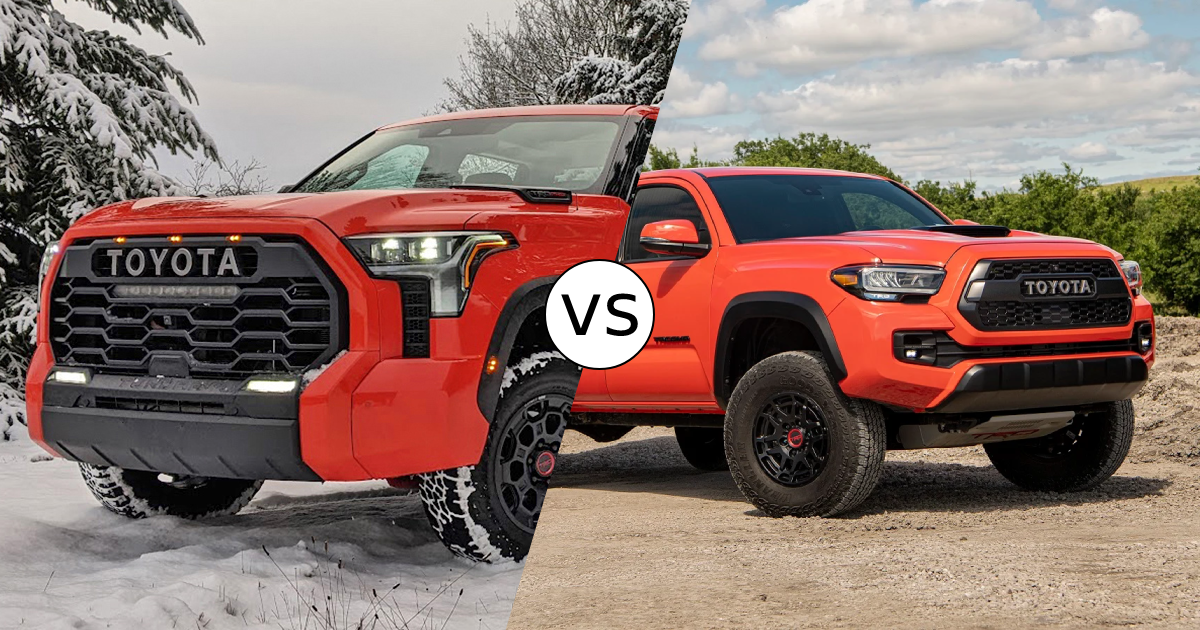
If you're in the market for a new truck, two excellent options for your consideration are the Toyota Tundra and Toyota Tacoma. These pickups both benefit from Toyota's high-quality design and construction, but they cater to slightly different types of customers. While the Tundra fits into the full-size pickup class, the Tacoma is a smaller, compact truck. We've taken a closer look at both of these vehicles’ features to help you decide whether the 2023 Tundra or Tacoma is the right choice for your next purchase.

Tundra vs. Tacoma: Overview

The main difference between these two trucks is their size. The big Tundra can measure up to 21 feet in length, depending on the cargo bed you choose. By contrast, the maximum length for the Tacoma is 18 feet 10 inches. This means that the Tundra offers more cargo space, but the Tacoma will be easier to handle on busy roads.

As you'd expect from a full-size truck, the Tundra also has more power under the hood and a higher towing capacity than the Tacoma. That said, the Tacoma's stats are more than capable of meeting the needs of many drivers.

Tundra vs. Tacoma: Engine and Performance

The Tacoma offers two engine options. The first is a four-cylinder unit that puts out 159 horsepower, which is enough for typical daily driving. If you plan on taking advantage of the Tacoma's solid 6,800-pound towing capacity, you should opt for the larger V-6 engine. It puts out 278 horsepower. The smaller engine has a towing capacity of 3,500 pounds, which is about enough for a midsize camper.

The Tundra also has two powertrain options, both of which supply considerably more horsepower. The base engine is a 3.4-liter twin-turbocharged V-6 that can put out up to 389 horsepower. The alternative option adds an electric motor to the mix to increase output to 437 horsepower. The Tundra's towing capacity is an impressive 11,120 pounds, making it a great choice for hauling heavy loads on the job site or a full-size camper out of town.

Tundra vs. Tacoma: Passenger and Cargo Capacity

You can choose from three cargo beds in the Tundra. The longest option measures 8 feet 1 inch, and it's only available with a compact cab. The two shorter beds measure 6 feet 6 inches and 5 feet 6 inches in length, respectively. In the Tacoma, you can choose between a bed measuring 6 feet 2 inches or a shorter one measuring 5 feet in length. What this means in practice is that unless you need the longest bed in the Tundra, you can access roughly the same amount of cargo storage in both trucks.

Both cab options in the Tundra offer seating for five people. The compact double cab has half-size rear doors and enough room in the second row for adults to travel on short trips. The Crew cab offers much more legroom in the rear row, making it ideal for longer trips. However, you'll’ need to choose from one of the two shorter bed options.

In the Tacoma, the standard Access cab can seat four people. The rear seats are quite small and best left for kids. If you step up to the larger Double cab, you gain a fifth seat and some additional space for back-seat passengers.

Tacoma vs. Tundra: Infotainment and Safety Features

The infotainment systems in both trucks are quite similar. The Tundra has an 8-inch entertainment display, while the Tacoma's screen is slightly smaller at 7 inches. Both trucks have a six-speaker stereo, Apple CarPlay, Android Auto, and Bluetooth. The Tundra's standard setup also includes a navigation system and a Wi-Fi hotspot. Optional upgrades in the Tacoma include an 8-inch display and a navigation system, while the Tundra offers a 14-inch display and a 12-speaker premium stereo. The Tundra also offers two 120-volt household power outlets.

Many of the same safety features are also offered in both trucks. These include forward collision warning, automatic emergency braking, and adaptive cruise control. You can add a surround-view parking camera to make the job of maneuvering into a parking spot a whole lot easier.

Tacoma vs. Tundra: Trims and Pricing

There's a big price difference between the base Tundra and Tacoma models. If you're buying a truck on a modest budget, the Tacoma's MSRP of $28,250 will be more attractive than the $38,965 for the Tundra. On the other hand, the Tundra offers much more capability when it comes to hauling heavier loads, as we've outlined above.

You can choose from seven trims in the Tacoma: the SR, SR5, TRD Sport, TRD Off-Road, Limited, Trail Special Edition, and TRD Pro. The TRD Sport is the first trim to offer the V-6 as the standard engine, while the lower two trims have it as an optional upgrade. The Limited trim adds real luxury to the cabin with heated front seats and leather upholstery, while the TRD Pro gets an off-roading suspension and multi-terrain monitor.

The Tundra also has seven trims: the SR, SR5, Limited, Platinum, 1794 Edition, TRD Pro, and Capstone. The Limited trim is the first one available with the more powerful engine, which you can add with the Crew cab as an optional upgrade. The Platinum trim gets genuine leather upholstery, heated and ventilated seats, and a heated steering wheel. The TRD Pro has just about everything you could want for off-roading, including all-terrain tires, an off-roading suspension, skid plates, and a forward-facing camera.

Want To Shop for a 2023 Tundra or Tacoma in Prosper, Texas?

We hope that this guide has helped you decide whether the Tundra or Tacoma is right for you. The Tundra is a great choice for a work truck or someone who needs to pull the heaviest loads. The Tacoma offers plenty of capabilities for most recreational towing needs and is easier to handle on the road. If you have further questions or would like to arrange a test drive in Prosper, Texas, don't hesitate to contact us here at Longo Toyota. One of our pickup sales experts will be happy to help you get the purchase process started.

Posted in:

Related Posts

2027 Toyota Prius driving through a curved tunnel

2027 Toyota Prius vs. Prius Plug-In Hybrid: Which One Makes More Sense?

If you're weighing the 2027 Toyota Prius vs Prius Plug-In Hybrid, the choice comes down to two questions. Can you charge at home or at work, and do you want to? And do you want to drive on electricity alone for part of your day? Both are exceptionally efficient, and the right one depends on how and where you drive. Ready to compare in person? Browse our Prius inventory at Longo Toyota of Prosper. 2027 Toyota Prius vs. Prius Plug-In Hybrid: At a Glance A fuel-economy rating only covers part of the value picture. Purchase price and charging access matter, as do your electricity rates and how often you'd really drive on electricity. How the car feels from the driver's seat and what technology it has count too. Availability, features, and specs vary by trim and may change, so confirm details with our team. This table compares the two models on price, charging, electric-only driving, efficiency, power and roadside coverage. All figures are for the 2027 model year, and efficiency and range are estimates. Spec 2027 Prius 2027 Prius Plug-In Hybrid Starting price $30,050 (LE FWD) $35,275 (SE) Charging No plugging in; battery recharges through braking energy Level 1 cable included for a 120V outlet (about 11 hours); optional Level 2 (about four hours), under ideal conditions Electric-only driving Selectable EV Mode for short, low-speed driving Up to 44 miles (SE); up to 39 miles (XSE, Nightshade, XSE Premium) Efficiency 55 mpg combined (LE FWD); 53 mpg combined (LE AWD) 51 mpg and 129 MPGe combined (SE); 47 mpg and 114 MPGe (other grades) Net-combined hp and est. 0–60 mph 194 hp, 7.2 sec (FWD); 196 hp, 7.0 sec (AWD) 220 hp, 6.6 sec Roadside assistance (ToyotaCare) 2 years 3 years I f you don't want charging in your routine, or you have no reliable place to plug in, the 2027 Toyota Prius fits better. If you can charge where the car sits parked and want electric-only driving for daily trips, the 2027 Prius Plug-In Hybrid deserves a look. Hybrid vs. PHEV: How Each Prius Works Both cars pair a gasoline engine with electric motors. The difference is how much outside electricity each can store and use for driving. The 2027 Prius hybrid uses Toyota's fifth-generation Hybrid System. It combines a 2.0-liter four-cylinder engine with two motor-generators through a continuously variable transmission. Its battery recharges from energy recovered during braking, so it never needs a plug. The Prius Plug-In Hybrid (previously called Prius Prime) uses a 2.0-liter inline four-cylinder engine with two motor-generators. It runs through a planetary-type continuously variable transmission and a 13.6-kWh lithium-ion battery. That larger battery allows farther electric-only driving. After the charge is used, it operates like a regular hybrid. Charging Requirements: No Plugging In vs. Outlet or Level 2 At home, the Prius hybrid needs nothing special. Fill the tank and go. The Prius Plug-In Hybrid comes with a Level 1 charging cable that plugs into a standard 120V household outlet (a dedicated 15-amp circuit is recommended), so you can start charging at home right away. For faster charging, you can add a Level 2 charger, a 240V unit similar to what powers a dryer, installed by a licensed electrician. Under ideal conditions, a full charge takes about 11 hours on a 120V outlet, enough for an overnight top-up, or about four hours on Level 2. And if you skip plugging in, it still runs as an efficient hybrid, so overnight or workplace charging matters more to daily convenience than occasional public charging. Electric-Only Driving and Battery Depletion The Prius Plug-In Hybrid offers up to 44 miles of electric-only driving on the SE and up to 39 miles on the XSE, Nightshade, and XSE Premium. Treat those as estimates. Speed and terrain change the result, as do temperature, climate control, and driving style. Texas summer heat and cold snaps can affect range and efficiency too. It has three modes for using that charge: EV Mode uses the battery alone when enough charge is available. Auto EV/HV Mode mainly uses battery power and switches to hybrid operation when more power is needed, such as on steep hills or at higher speeds. Hybrid Mode combines engine drive force and electric power. When the charge runs low, the hybrid system takes over. You aren't stranded when the electric range hits zero. The gas engine simply does more of the work. The Prius hybrid has a selectable EV Mode too, but only for short, low-speed driving, such as in parking garages. Fuel Economy and Performance Compared Efficiency numbers describe different things on each car, so compare them with care. Equivalent grades and drivetrains make the fairest comparison. All figures here are 2027 model year Toyota estimates, and EPA estimates vary with weather, speed, and driving style. MPG vs. MPGe: Toyota Estimates MPG is the distance a car travels on one gallon of gasoline. MPGe measures energy efficiency using a gasoline-equivalent energy figure. It lets you compare electricity use with fuel use, though it makes no promise about miles per gallon. The 2027 Prius earns an EPA-estimated 55 mpg combined on the LE FWD and 53 mpg combined on the LE AWD. The Prius Plug-In Hybrid SE is rated at 51 mpg combined in hybrid mode and 129 MPGe combined, while the XSE, Nightshade and XSE Premium are rated at 47 mpg and 114 MPGe. Your real-world running costs depend on your electricity rates, your driving habits and how many of your miles come from the plug, so the more often you charge, the more the Plug-In Hybrid’s efficiency pays off. Horsepower and Drive Feel The 2027 Prius makes 194 net-combined hp in FWD and 196 hp in AWD. Estimated 0-60 mph times are 7.2 seconds for FWD and 7.0 seconds for AWD. The Prius Plug-In Hybrid makes 220 net-combined hp, with an estimated 0-60 mph time of 6.6 seconds. You'll notice that gap on an on-ramp, since the Plug-In Hybrid is the quicker of the two. Both offer Normal and Sport drive modes, plus Eco. Normal balances economy and acceleration, Eco moderates power response, and Sport sharpens throttle response. Horsepower isn't everything, though. Ride comfort and seating shape the daily experience, and so do visibility and highway manners, so a test drive tells you more than a spec sheet. You can start with a virtual test drive. Purchase and Ownership Considerations The Prius comes in LE, XLE, Nightshade, and Limited grades. The Prius Plug-In Hybrid comes in SE, XSE, Nightshade, and XSE Premium. The XSE Premium offers an available 185W solar roof with limited availability. It can charge the drive battery while parked and power auxiliary functions while driving. The Prius starts at $30,050 for the LE FWD, while the Prius Plug-In Hybrid starts at $35,275 for the SE, a premium of roughly $5,200. Whether that pays off depends on your electricity rates, your driving habits and how often you charge. When comparing, line up similarly equipped models so the powertrain cost isn’t mixed up with trim differences, and ask our team about any current incentives that may apply. Both cars still have gasoline engines, so electric capability doesn’t remove engine maintenance. Both 2027 models carry Toyota’s Hybrid Battery Warranty for 10 years from first use or 150,000 miles, whichever comes first, and both include ToyotaCare’s factory-scheduled maintenance for one year or 10,000 miles. ToyotaCare’s 24/7 roadside assistance runs two years on the Prius and three years on the Prius Plug-In Hybrid. Our service center supports both, and on a tighter budget, our Certified Pre-Owned Toyotas are worth a look. You can also apply for financing online. Which Driving Patterns Favor Each Prius? Your routine decides this more than any spec. Picture a few common Prosper-area situations. If you drive from Prosper to nearby Frisco or McKinney and back, and the round trip fits within the electric range, a plug-in with a nightly charge suits you. A long highway commute is a different story. Daily miles up the Dallas North Tollway corridor leave little chance to use a bigger battery, and highway speeds can also reduce electric range, so the hybrid's simplicity is appealing. And if you live in an apartment or park on the street, the Prius hybrid avoids the charging problem entirely. Start with where you park overnight and how far you drive daily. Think about how often you take road trips, and whether you have a 240V outlet at home or charging at work. Choose the Prius Hybrid If… You want efficient driving with no plugging in. You have no convenient home or workplace charging. You prefer a routine that matches any gasoline car. You want an available AWD option, rated at 53 mpg combined on the LE. You like the idea of a short, low-speed EV Mode in places like parking garages. Choose the Prius Plug-In Hybrid If… You can plug in at a household outlet or a Level 2 charger where you park. You want electric-only driving of up to 44 miles on the SE or up to 39 miles on other grades. You want the quicker car, with 220 net-combined hp and an estimated 6.6-second 0-60 mph time. You want gasoline flexibility, since it operates like a regular hybrid once the charge is used. You're curious about the available solar roof on the XSE Premium. Explore Prius Inventory at Longo Toyota of Prosper Specs and comparisons can only tell you so much, and the best way to decide is to feel the difference from behind the wheel. Explore our Prius inventory at Longo Toyota of Prosper, then schedule a back-to-back test drive of both models on the Dallas North Tollway: notice the Plug-In Hybrid’s quick, quiet electric response and the Prius’s effortless efficiency, and you’ll know which one fits your routine. Have questions about home charging or trims? Contact our team, and we’ll help you find the right Prius.

2027 Toyota Sequoia driving down an open highway through the desert landscape

2027 Toyota Sequoia Trailhunter vs. TRD Pro: Which Is Better for Texas Adventures?

Choosing between the 2027 Toyota Sequoia Trailhunter and the TRD Pro comes down to purpose. Trailhunter is built for overlanding and camping. TRD Pro is the off-road-focused grade for trail driving. Both still have to handle North Texas commutes and towing. If you want to see what we have right now, browse new Sequoia inventory as you read. 2027 Toyota Sequoia Trailhunter vs. TRD Pro at a Glance Toyota is updating the 2027 Toyota Sequoia with new styling, Toyota Safety Sense 4.0, and the latest Toyota Audio Multimedia system. A Trailhunter package is newly available too. The updated Sequoia is meant for family road trips and weekend escapes. Trailhunter is a package based on the SR5 grade, designed to make adventure-ready capability more attainable, while TRD Pro is a separate, off-road-focused grade. For Texas buyers, terrain, camping gear, passengers and towing matter first, along with how the SUV fits daily driving. Rugged looks come well after that. What Toyota Has Confirmed and What Is Still an Expected Carryover With a new model year, transparency matters more than hype, so we sort the facts into three buckets. Confirmed for 2027: the updated styling, including a new front-end design with rectangular fog lights integrated into the bumper. Toyota Safety Sense 4.0, the latest Toyota Audio Multimedia system, and the Trailhunter package are also confirmed. The multimedia system has an intuitive, smartphone-like interface and integrates AT&T 5G connectivity. Expected carryover, not confirmed for 2027: the powertrain and other 2026 hardware. Every 2026 Sequoia has the twin-turbo V6 hybrid i-FORCE MAX powertrain, rated at 437 horsepower and 583 lb.-ft. of torque, with a 10-speed automatic. We expect it to carry over, but it isn't confirmed for 2027. Specs and features may change, so confirm details with our team or Toyota's official materials. We also can't confirm 2027 stock, ordering, or arrival dates. Trailhunter: Built for Overlanding and Camping Overlanding means traveling unpaved roads with people and camp gear on board. Toyota's Trailhunter package bundles trail equipment together, so you don't piece upgrades together yourself. Picture a gravel access road into a remote campsite, where the goal is steady, controlled progress with the family aboard. Suitability depends on the whole setup, including how you load the vehicle. Trailhunter isn't confirmed to include roof racks, tents, or other camping accessories, so ask us about anything beyond the listed equipment. Overlanding-Focused Equipment and Exterior Hardware The Sequoia Trailhunter rides on Michelin LTX Trail 265/70R18 tires and bronze-colored wheels, with exclusive badges. Up front, it adds recovery hooks and additional underbody protection. Underbody protection helps shield vulnerable components, but it doesn't make every obstacle a good idea. Recovery hooks give you attachment points, yet safe recovery still means using suitable equipment and proper procedures. Suspension and Capability for Remote Campsites The Toyota Sequoia Trailhunter uses Old Man Emu upgraded suspension. It also includes Multi-Terrain Select and Crawl Control, plus a locking rear differential. Those systems support traction and low-speed control in the right conditions. They can't make up for a bad route or a heavy load, and they certainly can't add clearance. We have no confirmed 2027 ground clearance, lift, or travel figures, so judge a remote campsite by the surface and your loaded weight. Suspension branding alone won't tell you. TRD Pro: Equipment Built for Off-Road Performance TRD Pro is the grade for drivers who want the Sequoia tuned for rough terrain and trail days. Think of a weekend trail run where body control and stability over bumps matter more than packing a tent. Design intent doesn't prove results, so we won't claim it beats Trailhunter everywhere. Either one depends on how you load and use it. Off-Road Suspension and Exterior Hardware The 2027 TRD Pro gets newly designed, Sequoia-tuned, adjustable FOX QS3 shocks. Toyota tuned them for better feel, stability, and adjustability over rough terrain. It also has standard red tow hooks and a new Honeycomb color. The available TRD Performance package adds hardware and tuning for drivers who want a more dynamic Sequoia on and off the road. For reference, the 2026 TRD Pro rode on 18-inch matte-black forged-aluminum BBS wheels with all-terrain tires and had 9.1 inches of ground clearance. Toyota hasn’t confirmed 2027 TRD Pro wheel and tire details yet, so ask us before comparing it to the Trailhunter component by component. Technology and Interior Features The latest Toyota Audio Multimedia system and Toyota Safety Sense 4.0 are part of the 2027 update, so they’re shared across both and shouldn’t sway you toward one or the other. TSS 4.0 includes a Pre-Collision System with Pedestrian Detection, Full-Speed Range Dynamic Radar Cruise Control, Lane Departure Alert with Steering Assist, Lane Tracing Assist, Automatic High Beams, Road Sign Assist and Proactive Driving Assist. For 2026 reference, the TRD Pro had Multi-Terrain Monitor, which uses the vehicle’s cameras to help you check the immediate surroundings for potential obstacles. The 2026 TRD Pro also had Multi-Terrain Select and an electronically locking rear differential for added traction in 4WD Low. Similar hardware may carry over, but it isn’t confirmed for 2027. If you'd like a feel for a Toyota before visiting, try our virtual test drives. Towing and Road Trips Across North Texas and Beyond Lake trips and campground runs often mean a trailer. For reference, the 2026 Sequoia lineup maximum is up to 9,520 lbs. That figure covers the 2026 lineup overall, not a specific Trailhunter or TRD Pro rating, and we have no confirmed 2027 tow ratings for either. Passengers, cargo, camp gear, and trailer tongue weight all use up payload, sometimes before you reach the tow rating. Confirm your towing needs against the specific vehicle's rating and your trailer's weight. For long highway days, plan your load and route realistically. Driver-assistance tech can lighten the workload, but it never replaces your attention. Everyday Usability for Prosper and DFW Drivers Most days, your Sequoia will spend its time on school runs, DFW commutes, and parking lots in Prosper. A trail is rare. Check garage fit, parking maneuverability, and visibility in person. Trail-focused equipment can also change ride comfort and cabin noise, so drive both on a route you know. For a baseline, every 2026 Sequoia came with Toyota Safety Sense 2.5, including Full-Speed Range Dynamic Radar Cruise Control, Lane Departure Alert with Steering Assist, Lane Tracing Assist and Road Sign Assist, plus standard Blind Spot Monitor with Rear Cross-Traffic Alert and Front and Rear Parking Assist with Automatic Braking on every grade. For 2027, TSS 4.0 carries forward core features like Lane Tracing Assist and Road Sign Assist and adds Proactive Driving Assist. Families get a 60/40 split, sliding, reclining third row, and for 2026 Toyota made power folding standard on every grade. The 2026 SR5 started with an 8-inch touchscreen and an available 14-inch screen, both with wireless Apple CarPlay and Android Auto, and for 2027 every Sequoia gets the 14-inch Toyota Audio Multimedia touchscreen as standard. Trailhunter vs. TRD Pro Comparison Table This table sets the two side by side, using confirmed 2027 facts and clearly marked expected items. Feature Trailhunter TRD Pro Base and focus Package based on the SR5 grade, built for overlanding Off-road-focused grade Suspension Old Man Emu upgraded suspension Newly designed, Sequoia-tuned, adjustable FOX enhanced QS3 shocks Tires and wheels Michelin LTX Trail 265/70R18 tires, bronze-colored wheels Not yet confirmed by Toyota for 2027 Recovery and protection hardware Front recovery hooks, additional underbody protection Standard red tow hooks Traction systems Multi-Terrain Select, Crawl Control, locking rear differential Not yet confirmed by Toyota for 2027 (2026 had Multi-Terrain Select and an electronically locking rear differential, expected) Powertrain (2026 reference) i-FORCE MAX, 437 horsepower, 583 lb.-ft., 10-speed automatic (expected) i-FORCE MAX, 437 horsepower, 583 lb.-ft., 10-speed automatic (expected) Drivetrain Not yet confirmed by Toyota for 2027 Part-time 4WD on 2026 model (expected) Safety and technology Toyota Safety Sense 4.0 and the latest Toyota Audio Multimedia system Toyota Safety Sense 4.0 and the latest Toyota Audio Multimedia system Best for Overlanding and camping Off-road performance and trail driving "Expected" means a 2026 detail that may carry over but is not confirmed for 2027. Which Sequoia Fits Your Texas Adventures? Neither is the winner for everyone. The right pick depends on your mix of highway miles, unpaved roads, towing, passengers, and gear. We'd rather give you a conditional answer than an unsupported ranking. Choose Trailhunter if you take weekend camping trips and want an integrated overlanding package on an SR5 base. Trailhunter also suits you if remote campsite access roads and controlled low-speed travel are your priority. Choose TRD Pro if trail days and off-road performance matter most. TRD Pro is also the one to look at if adjustable FOX QS3 shocks, the available TRD Performance package and the new Honeycomb color appeal to you. Browse Sequoia Inventory at Longo Toyota of Prosper Ready to compare? Browse our new Sequoia inventory to see what’s on the lot today, and ask our team about incoming 2027 Trailhunter and TRD Pro models as Toyota releases full details this fall. Have questions about pricing, packages, or a test drive? Contact our team at Longo Toyota of Prosper, 2100 W. University Drive, Prosper, TX 75078.

Toyota Grand Highlander

2026 Toyota Grand Highlander vs. 2027 Kia Telluride: Why the Toyota Wins

Three-row SUV shoppers in North Texas have two strong options this year, but they're not equally matched. The 2026 Toyota Grand Highlander vs Kia Telluride comparison comes down to hybrid maturity, documented safety data, and standard equipment Toyota includes from the base trim up. The specs below show why the Grand Highlander comes out ahead. If you want to skip ahead, you can browse our current Grand Highlander inventory right now. 2026 Toyota Grand Highlander vs. 2027 Kia Telluride: At a Glance The 2026 Grand Highlander is a carryover year for us with no major non-hybrid changes, while the Telluride skipped 2026 entirely and returns for 2027 as a fully redesigned second generation. Spec Grand Highlander (Gas) Grand Highlander (Hybrid MAX) Telluride (Gas) Telluride (Hybrid) Engine 2.4L turbo 4-cyl Turbo 2.4L + electric motor Turbo 2.5L 4-cyl Turbo 2.5L 4-cyl + 2 electric motors Drivetrain FWD standard, AWD available AWD only FWD/AWD FWD/AWD Transmission 8-speed automatic 6-speed automatic 8-speed automatic 8-speed automatic Horsepower/Torque 265 hp 362 hp / 400 lb-ft 274 hp / 311 lb-ft 329 hp / 339 lb-ft Fuel Economy 21/28/24 mpg 26/27/27 mpg 22 combined FWD (20 city/26 hwy), 20 combined AWD (18 city/24 hwy) Up to 35 mpg combined (EX FWD), 31 mpg AWD Towing Up to 5,000 lb Up to 5,000 lb Up to 5,000 lb 4,500 lb Grand Highlander's hybrid lineup has established output figures and a proven fuel economy track record. We'll dig into that further below. Meet the 2026 Toyota Grand Highlander LE, XLE, and Limited: Everyday Value and Comfort The LE trim starts things off with 18-inch wheels, LED head and taillights, a power liftgate, wiper de-icers, and keyless entry and start. Fabric-trimmed three-row seating comes standard, along with an 8-way power driver seat and a 4-way manual passenger seat. Every Grand Highlander, including the LE, gets a 12.3-inch Toyota Audio Multimedia touchscreen with wireless Apple CarPlay and Android Auto standard, no upcharge required. Step up to the XLE and you'll find heated front seats, a wireless charger, second-row sunshades, and synthetic leather upholstery. An available 8-seat bench configuration and 18-inch silver alloy wheels round out the upgrades. The Limited trim adds a memory driver seat, heated and ventilated front seats, and 20-inch wheels. LE pricing starts at $42,260, XLE from $45,030, and Limited from $49,760. Platinum and Hybrid Trims: Efficiency Meets Luxury Hybrid powertrains are available across LE, XLE, Limited, Nightshade, and Platinum trims, so efficiency isn't locked behind a premium price tag. The standard hybrid pairs a 2.5-liter four-cylinder with an electric motor through a CVT, producing 245 hp with FWD or AWD availability. For drivers who want more muscle, the optional Hybrid MAX combines a turbocharged 2.4-liter engine with electric assist for 362 hp and 400 lb-ft of torque, paired exclusively with AWD. Platinum and Hybrid Nightshade trims add heated and ventilated second-row seats. The top Hybrid MAX Platinum brings a panoramic roof, a 10-inch head-up display, a digital rearview mirror with HomeLink, and Traffic Jam Assist through a Drive Connect trial or subscription. AWD adds $1,600 across the lineup and comes standard on Platinum. Meet the 2027 Kia Telluride Kia skipped the 2026 model year entirely, moving from the 2025 version straight to a redesigned 2027 model with a bigger, boxier body and a more functional third row. The LX starts at $39,190 before a $1,545 destination charge, with a 12.3-inch touchscreen, wireless Apple CarPlay and Android Auto, cloth upholstery, and a second-row bench for 8-passenger seating. The S adds captain's chairs at $42,090, and the EX starts at $43,790. Eight-passenger seating is not offered across the full lineup, which narrows Kia's family-hauling flexibility next to the Grand Highlander's broader bench availability. Higher trims move toward luxury and capability, with the X-Pro adding 9.1 inches of ground clearance, all-terrain tires, and a standard tow hitch. Pricing tops out at $56,790 for the X-Pro SX Prestige, and the LX is up nearly $3,000 over the outgoing generation. Exterior Design, Size, and Capability Compared The redesigned Telluride grew to a 116.9-inch wheelbase and 199.2 inches overall. The Grand Highlander runs a 116.1-inch wheelbase and stretches to 201.4 inches, making it the longer vehicle of the two by more than 2 inches, with that length going into the third row and cargo hold. Towing favors Toyota's hybrid lineup. Both the gas and Hybrid MAX Grand Highlander are rated at 5,000 lb, while the Telluride's hybrid drops to 4,500 lb. For North Texas families towing a boat to Lake Lewisville, the Hybrid MAX means no trade between capability and fuel savings. Interior Space, Comfort, and Cargo Room Cargo capacity is where the Grand Highlander separates itself once you start loading up. It offers 20.6 cubic feet with all seats up, 57.9 with the third row folded, and a maximum of 97.5 with all rear seats down, enough to stack seven carry-on suitcases behind the third row. Kia lists the gas Telluride at 22.3, 48.7, and 89.3 cubic feet, with the hybrid a cubic foot lower at each measurement. The Telluride holds a small edge with every seat occupied, but the Grand Highlander opens up more than 8 additional cubic feet when you fold everything flat. The third row tells a similar story. The Grand Highlander gives back-seat passengers 33.5 inches of legroom against the Telluride's 32.1, with headroom within a fraction of an inch. Toyota also offers eight-passenger bench seating across more of the lineup. If your third row carries adults regularly rather than occasionally, the Grand Highlander is the one built around that. Powertrain Performance and Fuel Efficiency Grand Highlander's standard gas engine is a 265-hp turbocharged four-cylinder paired with an 8-speed automatic, running FWD standard with AWD available for $1,600 more. FWD models return 21 mpg city, 28 highway, and 24 combined. The Telluride's gas engine is a turbocharged 2.5-liter four-cylinder producing 274 hp and 311 lb-ft, which is 17 hp less than the prior generation's 3.8-liter V6 but 49 lb-ft more torque. Reviewers have split on how that trade plays out in practice, with some noting the extra torque arrives early and others finding the four-cylinder less eager than the old V6 at higher revs. Toyota's 265-hp turbo four sits in the same neighborhood on output, and buyers who want real acceleration have the 362-hp Hybrid MAX available without leaving the lineup, an option Kia does not match on either powertrain. Why the Grand Highlander's Hybrid Advantage Matters Grand Highlander's standard hybrid delivers 245 hp with an EPA-rated 37 mpg city, 34 highway, and 36 combined on the FWD XLE, a fuel economy figure built on years of proven hybrid engineering. The Hybrid MAX pushes output to 362 hp and 400 lb-ft while still returning 26/27/27 mpg, giving drivers a genuine performance option without leaving efficiency behind. Kia's Telluride hybrid pairs its turbo 2.5-liter engine with two electric motors for 329 hp and 339 lb-ft, reaching up to 35 mpg combined in the best-case EX FWD trim or 31 mpg with AWD. Those numbers look competitive on paper. What's new is the combination: this turbo-hybrid powertrain is making its debut in a first-year redesign, and it's the first Kia hybrid assembled in the United States, at the company's West Point, Georgia plant. That means there is no model-specific reliability data for it yet. Toyota's hybrid system, by contrast, has been refined across multiple generations, and Consumer Reports singled out the Grand Highlander Hybrid as a standout performer in its 2026 reliability survey. Toyota also backs the hybrid battery for 10 years or 150,000 miles. That combination counts for something if you're commuting across North Texas daily or planning a long road trip with three rows packed full of gear. Technology, Safety, and Driver-Assist Features Every Grand Highlander trim, starting with the LE, comes standard with Toyota Safety Sense 3.0, adaptive cruise control, lane-keeping assist, automatic emergency braking, blind-spot monitoring, and rear cross-traffic alert. The 12.3-inch touchscreen with voice control is standard across the board too, so you're not paying extra for baseline safety and connectivity. IIHS has put the Grand Highlander through the full battery, and the results are on the record. It earned good ratings in passenger-side small overlap, moderate overlap, and updated side impact, plus superior marks for daytime and nighttime pedestrian crash prevention. An acceptable driver-side small overlap rating keeps it out of Top Safety Pick contention, though the dummy measurements showed no elevated injury risk to front occupants. The redesigned 2027 Telluride has not been crash-tested by IIHS or NHTSA at all. One side has a published picture, the other has nothing yet. Pricing, Reliability, and Long-Term Value On paper, the Telluride's LX starts lower at $39,190 (before destination) compared to the Grand Highlander LE's $41,360. The Telluride S starts at $42,090 and the EX at $43,790, compared to our XLE at $44,130 and Limited at $48,860. Reliability is where the long-term math shifts firmly in Toyota's favor. Consumer Reports ranked Toyota the #1 most reliable brand for 2026 with a reliability score of 66, ahead of Subaru at 63 and Lexus at 60. J.D. Power's dependability studies consistently place Toyota and Lexus at the top of the industry. Kelley Blue Book's expert reviews also point to the Grand Highlander's strong resale value, tied directly to Toyota's reliability reputation. When it comes to Kia Telluride vs Toyota Grand Highlander reliability, the data favors Toyota's track record over Kia's brand-new hybrid system with no history yet. Final Verdict: Why the 2026 Toyota Grand Highlander Wins Line up the Toyota Grand Highlander vs Kia Telluride specs side by side, and the Grand Highlander wins on the factors that matter most for long-term ownership. Grand Highlander offers broader 8-passenger seating availability across the lineup, a hybrid powertrain with a proven track record and documented fuel economy, standard safety technology backed by real IIHS crash-test data, and reliability rankings that lead the industry according to Consumer Reports and J.D. Power. The Telluride brings bold styling and strong base-trim value, but Kia is asking buyers to sign on for a redesign with no crash-test results and a first-generation hybrid system. For families comparing Highlander vs Telluride or Grand Highlander vs Telluride options in North Texas, the Grand Highlander delivers verified performance where the Telluride is still asking buyers to take it on faith. Test Drive the Grand Highlander at Longo Toyota of Prosper We'd rather you experience these numbers firsthand than just read about them. Longo Toyota of Prosper operates from a $25 million, 15-acre facility at 2100 West University Drive in Prosper, Texas, and we've proudly carried the title of the nation's #1 volume Toyota dealership for over 55 years. Explore a virtual test drive from home, or browse our current Grand Highlander inventory to find the trim that fits your family. When you're ready to talk specs, financing, or scheduling a visit, contact our team and we'll get you behind the wheel.